

- The Xunta is today publishing in the Official Gazette of Galicia the new calls aimed at attracting major flagship projects and supporting small and medium-sized enterprises in the province of A Coruña
- “We are not here to talk about closures, but about openings, about new projects in these districts,” said Lorenzana
- Corgos points out that European funds are one of the main drivers of Galicia’s economic development
As Pontes de García Rodríguez (A Coruña), 30 January 2026
The Regional Minister for Economy and Industry, María Jesús Lorenzana, today announced the launch of new lines of aid that will mobilise more than 100 million euros from the Just Transition Fund to attract major industrial projects and support SMEs in the province of A Coruña, as published today in the Official Gazette of Galicia (DOG). The aim, she stressed, is to promote reindustrialisation and employment in the areas affected by the closure of the coal-fired power stations of As Pontes and Meirama.
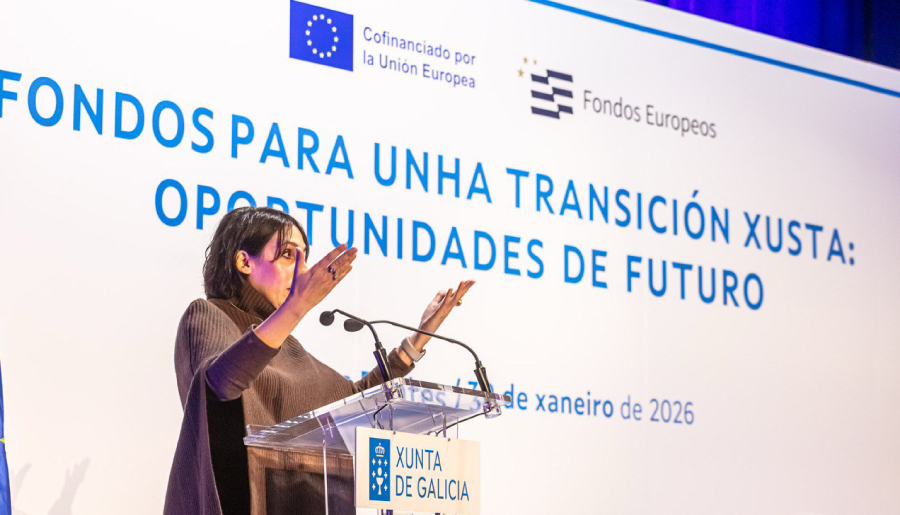
She underlined this during the event Funds for a just transition: Future opportunities, which was also attended by the Regional Minister for Finance and Public Administration, Miguel Corgos, where she reaffirmed the Galician Government’s commitment to the economic reactivation of these municipalities and also of the neighbouring areas (the districts of Ferrolterra, Eume and Ordes, as well as the municipalities of Laracha, Carral, Ortigueira, Cerdido and Mañón). The subsidised projects must be located in one of these areas.
The Regional Minister highlighted that tomorrow the application period will open for the line of aid for which the Xunta is allocating 80 million euros with the aim of financing decarbonisation and industrial renewal projects for major companies capable of transforming the productive fabric, modernising industrial processes and generating sustainable economic activity in the medium and long term.
For its part, the Xunta is allocating a further 22 million euros to a new round of partially repayable loans for SMEs in the province of A Coruña, which may be applied for from next 9 February.
The application period is three months in both cases, with the aim of facilitating companies’ access to the aid and financing provided for in these support schemes, which are co-financed by the European Union through the 2021-2027 Just Transition Fund programme.
Fighting against “no as a matter of principle”
“We are not here to talk about closures, but about openings, about new projects in these districts,” said Lorenzana, who expressed her gratitude to all the workers who “managed to turn these two districts and all their areas of influence into top-level industrial zones in Spain”.
“I hope that this aid, together with all the work that we businesspeople, workers and the administration itself are doing, will ensure that this absolutely industrial area of Galicia continues to be so,” she went on, adding: “If we had organised this transition process in As Pontes with the level of cooperation expected from the administrations, without any doubt it would have been considerably fairer.”
In this context, Lorenzana called for “a fight against ‘no as a matter of principle’”. “It cannot be that every time a business, industrial or energy initiative is proposed, there are people willing to say no without even knowing what the initiative is about,” she stressed. “This means that Galicia loses opportunities and that other territories gain them. Galicia is not stuck in the past,” she stressed.
The Xunta and Galicia’s most representative social partners (UGT, CCOO, Asime and the A Coruña Business Confederation) have signed the As Pontes-Meirama 2025-2028 Comprehensive Action Plan (PAI) for the professional retraining, improvement of employability and reintegration into the labour market of workers affected by the closures of the power stations. Within this plan, the Activa Verde project stands out, aimed at supporting 900 participants with guidance programmes, training in renewable energies and assistance with job relocation.
The importance of European funds
For his part, the Regional Minister for Finance and Public Administration, Miguel Corgos, highlighted the importance of the European Union for the business reality of Galicia. “Galicia is Europe,” he stated, “and European funds are one of the main drivers of our economic development.” These are real investments that make it possible “to innovate, grow, modernise processes, commit to the green transition, internationalise and generate quality employment. In short,” Corgos concluded, “they are key tools for advancing the Galician productive fabric.”
Miguel Corgos chaired the panel Real experiences: European funds activate opportunities for businesses, at which three business owners explained what this support means in their day-to-day reality and its impact on the growth of their companies, their competitiveness and the territory.


