

- She noted that the Regional Government of Galicia is currently processing 16 strategic industrial projects representing a total investment of €1.7 billion and the potential creation of 3,700 jobs across the region.
- She highlighted the importance of a “collective conviction” in the capabilities of Galician industry and the belief that “Galicia can occupy a leading position from an economic perspective.”
Vigo, June 4, 2026
The Minister of Economy and Industry, María Jesús Lorenzana, today highlighted the seriousness, productive capacity, and talent consistently demonstrated by Galician industry, and called on stakeholders not to be influenced by what she described as a denialist movement seeking to undermine Galicia’s industrial future.
“Reality shows that we are genuinely competing, on equal terms, with the most advanced regions in Europe and that we are capable of generating world-class industrial value here,” she said. Therefore, she continued, “it is important that we do not allow ourselves to be influenced by a movement that has supporters within certain trade union and environmental organizations and whose sole mission is to undermine Galicia and halt its industrial development.”
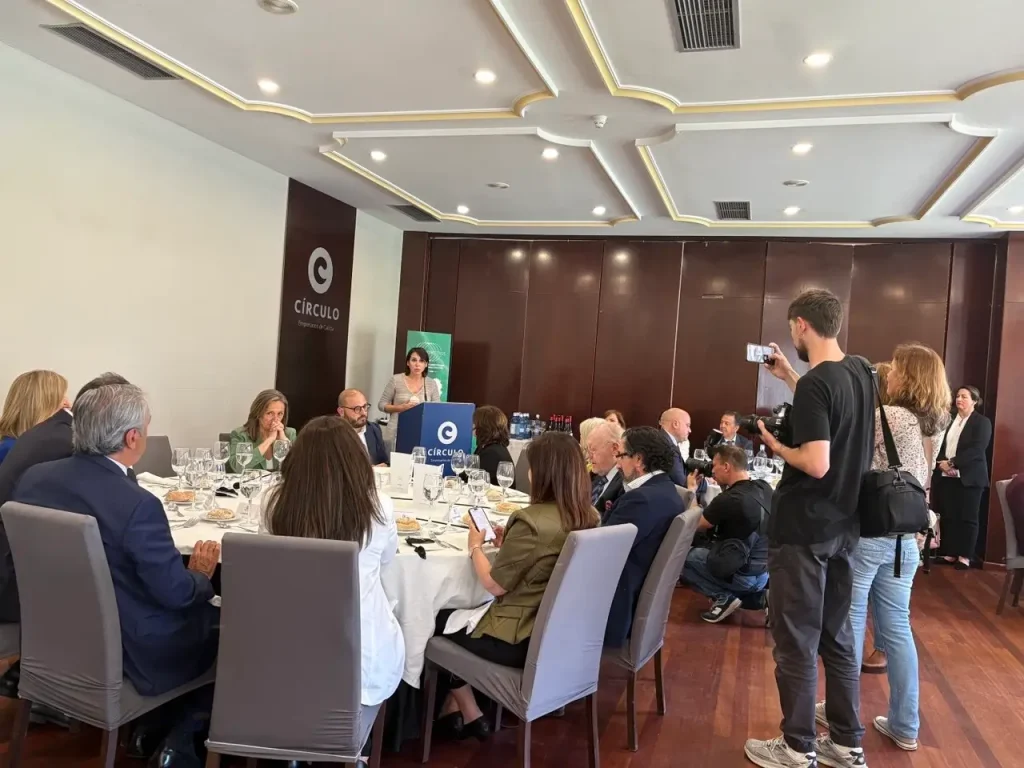
Lorenzana spoke today at a business luncheon organized at the Galicia Business Circle as the opening event of the Capacita Directivos executive training program, promoted by the Galician Institute of Economic Development (Igape). During her speech, she emphasized the importance of fostering a “collective conviction” regarding the capabilities of Galician industry and the belief that “Galicia can occupy a leadership position from an economic standpoint.”
In this context, she noted that the Regional Government is currently processing 16 strategic industrial projects with a combined investment of €1.7 billion and the capacity to generate 3,700 jobs throughout Galicia. Among them, she referred to the most recently approved initiative: the industrial complex that SAIC plans to establish in the Ferrolterra region.
“If we succeed in bringing this project to fruition, its dimensions will be extraordinary, not only for the region where it will be located—a territory that needs industrial diversification—but also for the entire industrial sector in Vigo and, particularly, for companies within the automotive value chain,” she stated.
According to Lorenzana, “SAIC is arriving with a commitment, as it should, and as we are requiring, to local procurement and local hiring. This will provide our suppliers with an enormous opportunity, first, to stabilize their production and, second, to offer and establish commercial partnerships with a company that also operates across many different business lines.”
Regarding the Capacita Directivos program, which has been promoted by the Galician Institute of Economic Development (Igape) for more than a decade, she explained that it has delivered more than 100 training activities attended by over 20,000 participants. It is an initiative, she said, that responds to the need to understand that “companies do not change when technology changes; they change when decisions change.”


