

- She recalled that the Xunta has been holding monthly meetings with the Ministry of Economy, Trade and Industry through the Interterritorial Internationalization Council, as well as with ICEX and the Directorate General for International Trade and Investments.
- She announced that next Monday, May 26, a second meeting will take place with the economic sectors most affected in Galicia to explain the terms of the Xunta’s announced working capital loan program of up to €1 million.
- She highlighted that Galician exports to the United States increased by 40.6% year-on-year in March (€52.84 million) and, cumulatively from January to March, by 4.7%, reaching €161 million.
Santiago de Compostela, May 21, 2025
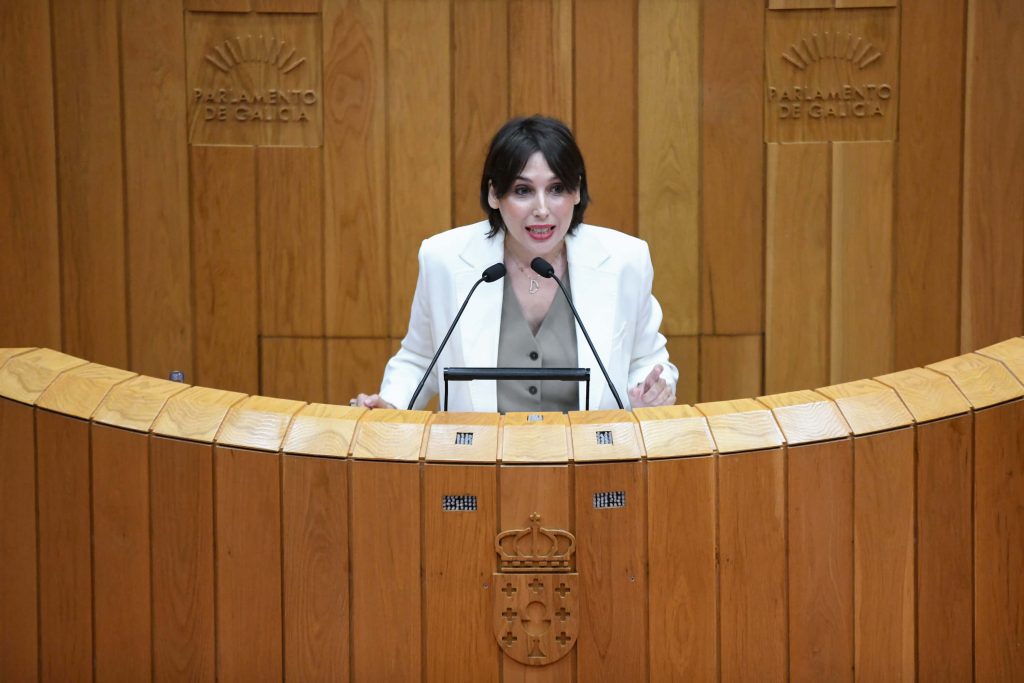
The Regional Minister for Economy and Industry, María Jesús Lorenzana, today called for coordinated action with the Spanish Government and the European Union to defend the interests of Galician companies while awaiting clarity on the final tariff scenario. “We must try to reduce this trade war as much as possible and seek negotiation. This is the first issue on which we need to work in coordination with the EU and the Government of Spain,” she said.
In response to a parliamentary question during the plenary session of the Galician Parliament, Lorenzana recalled that the Xunta has been holding monthly meetings with the Ministry of Economy, Trade and Industry through the Interterritorial Internationalization Council, specifically on April 10 and May 19. She also noted that meetings are being held through Igape with ICEX and the Directorate General for International Trade and Investments to monitor the impact of escalating tariffs. “We still do not know which tariffs will ultimately be imposed or when,” she observed.
On the Xunta’s side, she assured that permanent contact is being maintained with the productive sector and announced that next Monday, May 26, a second meeting will take place with the economic sectors most affected in Galicia to explain the terms of the Xunta’s announced working capital loan program of up to €1 million. “As soon as they submit their feedback, it will be officially published in the Official Gazette of Galicia (DOG),” she stated.
Among the measures implemented by the regional government, she recalled that the Economic Office of the Galician Institute for Economic Promotion (Igape) has created a specialized support unit with specific services, coordinated with its Miami office, from where webinars with companies have been organized this week. Today’s session focused on the stone and construction materials sector, while tomorrow’s will target biotech and ICT companies. In addition, within the framework of the Reacciona program, a new specialized internationalization consultancy service is expected to be launched soon. This response plan, she added, is coordinated with that of the Spanish Government and included in the ICEX High Impact Competitiveness Plan.
An Outstanding Export Cycle
In this context, Lorenzana emphasized the “outstanding” export cycle currently being experienced by Galicia, which achieved “the best export figures in history” in 2024, reaching €31.019 billion, representing growth of 3.3% compared to the previous year.
So far in 2025, she continued, the region has maintained a strong position within Spain, accounting for 8.1% of total Spanish exports recorded in March, when Galicia reached €2.7469 billion, significantly above the €2.4538 billion recorded in the same month of 2024—an increase of 12%. The cumulative trade balance for 2025 also shows a value of €2.2139 billion.
Regarding trade relations with the United States, she highlighted that exports in March increased by 40.6% year-on-year, reaching €52.84 million. Likewise, cumulative exports from January to March grew by 4.7% compared to the same period the previous year, reaching €161 million.
Even so, she pointed out that the United States is only the eleventh-largest market for Galician exports, whose primary destination remains the European Union. Concerning the sectors most affected in Galicia, she mentioned the chemical industry (nearly €200 million in exports to the U.S.); the agri-food and bio sector (€135.8 million); metalworking (€114 million); shipbuilding (€92 million); and mineral products and automotive industries (nearly €60 million).
“What concerns us most is the indirect effect of reciprocal tariffs on imports and on trade relations with the EU, and how these may affect Galician producers,” she concluded, calling for caution and the need to “remain alert.”


