

- On May 18, the Xunta, Recursos de Galicia (RDG), and mayors and business representatives from the municipalities where this wind farm is located (Ribadeo, Trabada, and Barreiros) will hold an initial meeting.
- Work is already underway to activate discounts for households closest to this facility, which will receive up to an 80% reduction in their electricity consumption costs.
- “If we want industry in a territory, we must know how to create the right conditions; industry does not arrive by chance, it comes because there is a clear economic policy,” she said.
- The conselleira do Medio Rural, María José Gómez, who opened the event, encouraged industry to take advantage of the resources, knowledge, and quality potential of Galicia—and A Mariña in particular—in the primary sector to generate value and compete strongly in the market.
Ribadeo (Lugo), April 30, 2026
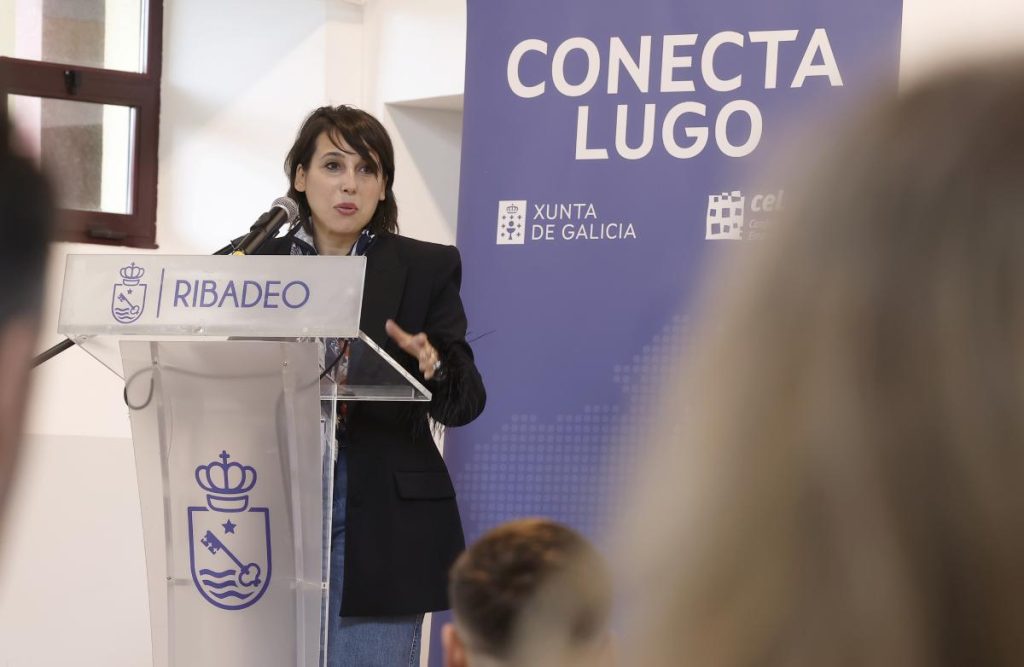
The Regional Minister for Economy and Industry, María Jesús Lorenzana, announced today that on May 18 the Xunta, Recursos de Galicia (RDG), and mayors and business representatives from the municipalities where the Mondigo wind farm is located (Ribadeo, Trabada, and Barreiros) will begin work on establishing the discounts that will also benefit businesses located in population centers near this facility.
During the closing session of the Business, Industry and Innovation forum, organized as part of the Conecta Lugo program, Lorenzana recalled that work is currently underway to activate discounts for households closest to this wind farm, which will receive up to an 80% reduction in their electricity consumption costs. In the coming weeks, the industrial plan to extend these incentives to local businesses will also begin to be designed.
The minister stated that Mondigo is a project that reflects the objective of the Xunta’s energy policy: “Ensuring that energy generation has a direct return for residents and businesses.” “Today there is no industry without energy,” she pointed out. “If we want industry in a territory, we must know how to create the right conditions,” she said. “Industry does not arrive by chance; it comes because there is a clear economic policy.”
In this context, Lorenzana also expressed support for “facilitating business establishment by removing barriers, reducing timelines, and supporting companies,” as the Xunta is doing through the Galicia Economic Office. “Every project that is not addressed, every investment that is not supported, is a missed opportunity,” she stressed.
“This is the change we are trying to promote: moving from an administration that simply responds whenever it can to one that truly leads economic support across the territory,” she said, while also highlighting the need to streamline procedures for industrial land availability and to create industrial ecosystems.
The Enormous Potential of A Mariña
For her part, the Regional Minister for Rural Affairs, María José Gómez, opened the forum and called on industry to take advantage of the “enormous potential” offered by Galicia in general, and A Mariña in Lugo in particular, within the primary sector. She stressed that “those who know how to optimize these strengths will not only generate value here, but will also compete strongly in an increasingly demanding global market.”
In this regard, Gómez defended the region’s resources, expertise, and quality-based model, encouraging stakeholders to maximize their value by focusing on three key pillars: agriculture, forestry, and the sea.
Regarding agriculture, she highlighted Galicia’s leadership in the dairy sector, not only in production volume but also because around 75% of the milk produced is processed locally. She also emphasized the strength of other sectors such as meat production, horticulture, cut flowers, and ornamental plants. All of this, the minister noted, is supported by a more diverse, technical, and business-oriented model driven by innovation and public support, particularly in training, through centers such as the Pedro Murias Agricultural Training Center (CFEA) in Ribadeo.
Regarding forestry, Gómez stated that “the forest is much more than landscape; it is economy, employment, and territorial balance,” something especially visible in areas such as A Mariña. She also stressed the importance of incorporating technology and promoting training in this sector to improve productivity, management, and wildfire prevention.


