

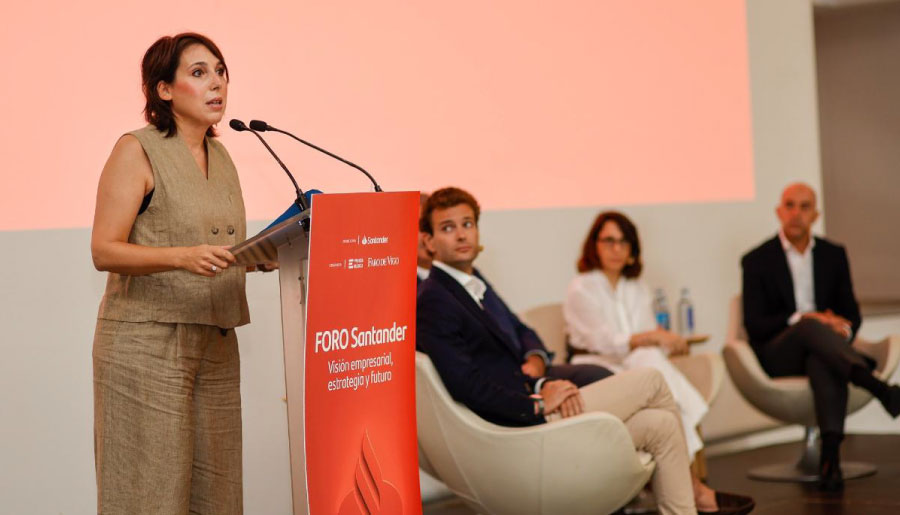
- “The large investments do not arise on the day they are announced. On that day they become visible, but they begin much earlier,” she says
- She assures that Galicia has been creating for years the conditions that companies now demand and that the aim is not to attract isolated investments, but to build a portfolio of projects capable of transforming the Galician economy
- “When an international company decides to develop a project, it is issuing a judgement on that territory; it is saying that it has found the conditions to trust. And that has enormous value,” she maintains
Vigo, 7 July 2026
The Regional Minister for Economy and Industry, María Jesús Lorenzana, highlighted today that the Xunta is developing an industrial policy of anticipation so that Galicia is ready before the opportunity arrives. “Industrial leadership is built on anticipation, also on responsiveness, and on the willingness to understand how companies make their decisions,” she says.
In her speech at the Santander Forum: Business vision, strategy and future, Lorenzana stressed that “large investments do not arise on the day they are announced. On that day they become visible, but they begin much earlier,” she said. “They begin when a territory prepares the business land that companies will need; when it invests in talent before demand appears; when it strengthens its innovation system; when it plans its infrastructures; and when it incorporates energy as an essential factor of industrial competitiveness”.
As she pointed out, Galicia has been creating for years the conditions that companies now demand. “We are not looking to attract isolated investments. We are looking to build a portfolio of projects capable of transforming the Galician economy,” she assured, adding that, at present, there are 17 industrial projects declared as strategic, supported by the Galicia Economic Office, which provides an integrated response throughout the investment process.
She also noted that, while over forty years Galicia developed a little more than 11 million square metres of public land, measures are now underway that will make it possible to add nearly 12 million more by 2030, with an investment of more than 440 million euros. “When a company is deciding where it will grow, every square metre of available land means that it can choose Galicia and therefore a project can start earlier and a job can come sooner,” she stated.
In this context, she also pointed out that, as “the capacity to manufacture will continue to be decisive, but the capacity to innovate will make the difference”, the new Galician Innovation Strategy will mobilise more than 400 million euros, reinforcing knowledge transfer, collaboration between companies and technology centres, and the incorporation of innovation into the productive fabric.
“When an international company decides to develop a project, it is issuing a judgement on that territory; it is saying that it has found the conditions to trust. And that has enormous value,” she emphasised. “Ultimately, a prepared territory is one that combines industry, knowledge and execution capacity. And that is the model that Galicia chose to bet on”. “I am convinced that we will be able in the coming years to change our position on the European industrial map,” she concluded.


