

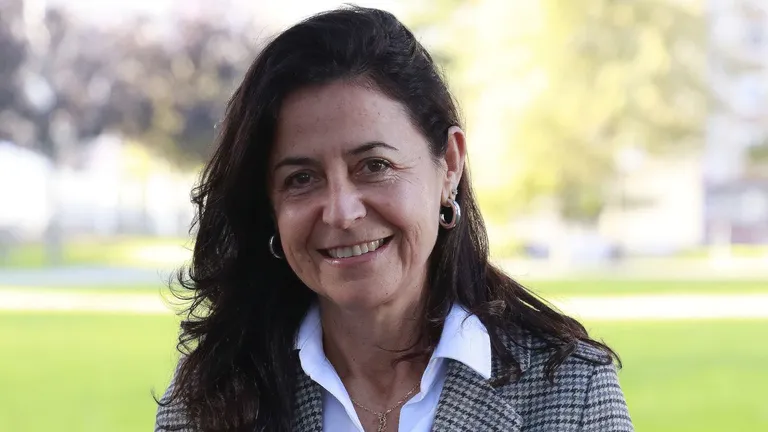
This entity will be introduced on 19 November at the employment fair organised by the School of Labour Relations
It is not just another office. “It is a single contact and support point for any business initiative developed in Galicia,” explains A Coruña‑born Natalia Barros about the body she directs. Its presentation in A Coruña will be the main event of the Fair for Business and Employment, organised by the School of Labour Relations in collaboration with the Xunta, from 19 to 21 November.
— What is the main mission of the Economic Office of Galicia?
— To facilitate the development of projects promoted by anyone from entrepreneurs to established companies in Galicia, or by external firms wishing to invest here.
— How was the process from the beginning?
— After several preparatory months to set up the new office, we began operating at the Igape premises in Santiago in April. In fact, the Economic Office was created under the Fiscal and Accompanying Measures Law of December 2023.
— What was its founding purpose?
— It was established to bring together and simplify several bodies previously created for similar tasks. There were already various investment‑support offices, such as the Galicia‑Empresa unit or the entrepreneur assistance unit. The idea was to consolidate their functions into a single, central point while adding new roles and objectives.
— How many people are currently part of the team?
— There is a core team of 27 information specialists in grant advisory services, and in September another 100 expert advisers joined in areas such as innovation, competitiveness, energy and industry.
— How many companies have you helped since your launch in April?
— According to our recent balance, we have handled 10,500 enquiries and held over 500 business advisory meetings.
— What is the most common type of enquiry?
— What we call “quick consultations” — for example, questions about Igape aid programmes (or similar), about case filings, how to submit an application or where to turn to establish a company.
— How many projects are currently being managed?
— We now have 165 particularly significant projects in our database, each involving investment volumes exceeding €800,000.
— What types of companies have used your services?
— Everyone from entrepreneurs looking to start a business to start‑ups and technology‑based projects. There are many from small and medium‑sized firms (perhaps the largest group) seeking to expand or diversify, as well as large companies with turnovers exceeding €50 million and over 250 employees. We have also received numerous projects from companies outside Galicia wanting to invest here. We are very pleased about this, because it shows that Galicia is perceived as a friendly region for investment. The feedback we receive is that they value having a single, coordinated information point, so they don’t have to search separately for who to contact regarding land, energy, financing or innovation aid.
— Where is most of the new activity and investment happening?
— Along the sea‑industry value chain, in the energy sector and, lately, the shipbuilding sector has been reviving strongly. There is also a great deal of activity in offshore wind development, component manufacturing and repowering. Currently, there is substantial interest in advancing that industry. The tourism sector is also active, with smaller‑scale investments focused on developing new forms of sustainable accommodation.
“We work with everything from a green‑hydrogen plant to small rural tourism enterprises.”
Natalia Barros is convinced that the Economic Office of Galicia, a recently established entity, has arrived at the perfect time given the “ecosystem” now emerging in A Coruña to support the development of business projects.
— What types of firms do you cover?
— From a sectoral perspective, the scope is very diverse. We assist everything from major industrial projects such as the establishment of a green‑hydrogen plant to small rural tourism rehabilitation ventures.
— How strong is interest in A Coruña?
— It is true that there is greater momentum along the Atlantic corridor. In A Coruña specifically, activity linked to the Outer Port of Punta Langosteira (hydrogen, offshore wind and other industries like malt production) is driving significant business and industrial development. In addition, the availability of land at the Morás industrial estate is generating strong interest in high‑impact projects that will stimulate economic activity across the region. The Just Transition Fund for regions affected by the closure of power plants (such as Meirama and As Pontes in this province) will also serve as an important instrument to boost business. At the same time, there is a great deal of entrepreneurial activity in A Coruña in the technology sector, driven by the impact of the City of ICT, the University of A Coruña’s degrees in Computer Science and Artificial Intelligence, and the presence of Aesia. Major companies based here are also strongly promoting entrepreneurship.
— Does the area have great potential?
— Yes, it certainly does. We can see it clearly through the enquiries we receive.
Who she is: Natalia Barros (Oza dos Ríos, 1969) knows the business world from various angles. She has worked in both large and medium‑sized enterprises and also understands entrepreneurship, having once created her own tourism project. She has served as Director of the Ferrol Plan, as a member of the Industry Committee in the Galician Parliament, and as Head of Strategic Projects at Igape.


