

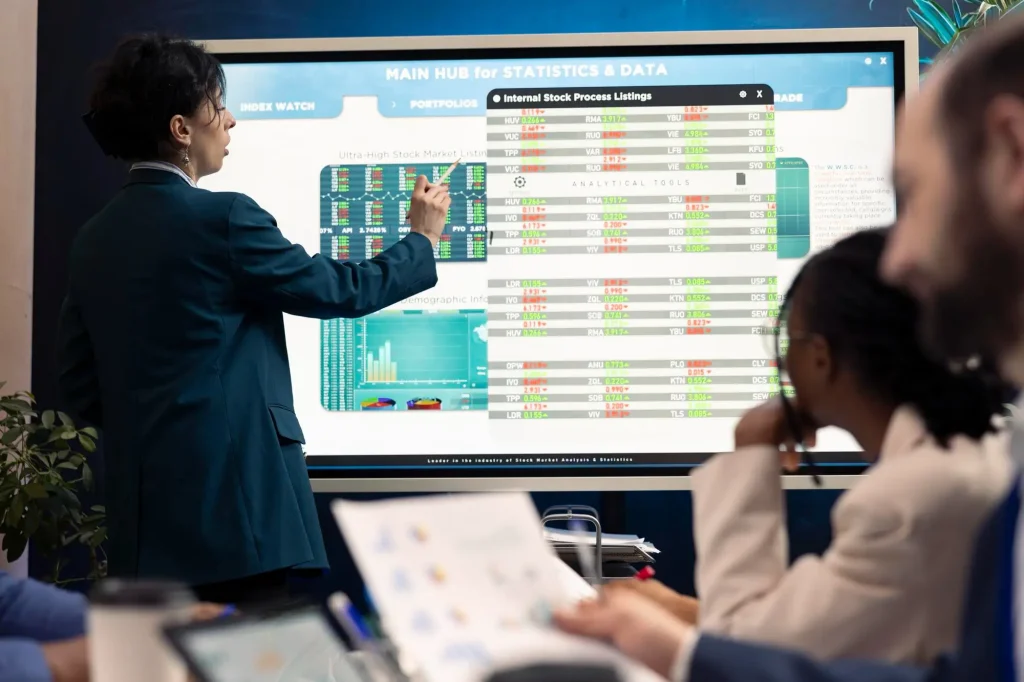
In most small and medium-sized enterprises (SMEs), data is available in abundance: sales, expenses, orders, working hours, customer incidents… The problem is rarely the lack of information, but rather its fragmentation. Each piece of data is stored in a different file (or several), managed by a different person, and updated at different intervals. As a result, despite constantly generating information, it can be difficult to know with certainty what is really happening in the business when it comes time to make a decision.
The cost of fragmented information
When information is spread across multiple spreadsheets, applications, or documents that do not communicate with one another, even the simplest question becomes a time-consuming task. Finding out last month’s revenue, identifying which products have the lowest turnover, or determining how many customer issues were resolved on time may require cross-checking several files and spending valuable time that could be devoted to higher-value activities.
Beyond the time lost, this fragmentation carries a less visible but far more significant cost: decisions tend to be based on general impressions or on the memory of those who have been with the company the longest, rather than on reliable, up-to-date data. This does not necessarily mean those impressions are wrong, but they are more susceptible to bias and outdated information that concrete data could help correct.
What is a dashboard, really?
A dashboard is a carefully selected set of key performance indicators (KPIs), presented visually and kept up to date, that provides a quick overview of the business and supports decision-making. Its value does not depend on the amount of data it contains, but on the quality of the selected indicators: a dashboard with twenty irrelevant metrics is far less useful than one with five well-chosen ones.
The key is to choose indicators that answer the questions the business asks most often: Are we generating more or less revenue than last month? What percentage of orders are delivered on time? How long does it take us, on average, to collect payments? Which customers generate the highest margins? There is no universal dashboard suitable for every business; each company should define its own based on its specific needs, priorities, and the decisions it makes—or needs to make—most frequently.
How to get started, step by step
Building a dashboard does not require sophisticated tools in its early stages. A practical starting point is to identify between three and five questions that repeatedly arise during company meetings and then determine which specific data answers each question and where that information is currently stored.
The next step is to centralize that data in a single reference point, even if it is initially something as simple as a well-structured spreadsheet, and establish who is responsible for keeping it updated and how often. Only once this habit has been established does it make sense to consider more advanced data visualization tools that automate updates and make real-time information easily accessible.
From intuition to evidence
Adopting a dashboard is not about replacing the judgment of the people who lead the company, but about giving them better support. Experience and intuition remain extremely valuable, but they become much stronger when validated against accurate, up-to-date data. Companies that take this step often discover that many decisions previously made “by gut feeling” can instead be supported by evidence that is readily available, without requiring a disproportionate investment or technical complexity for a business of their size.
So, how can the Galicia Economic Office help me in the area of OPERATIONS?
The Operations support and advisory area of the Galicia Economic Office is designed to help your company across all operational areas by providing agile, tailored solutions that meet your specific needs. The experts involved in the program will work closely with your business to analyze your operations, identify opportunities for improvement, and design effective implementation strategies. Request your free advisory service.


