

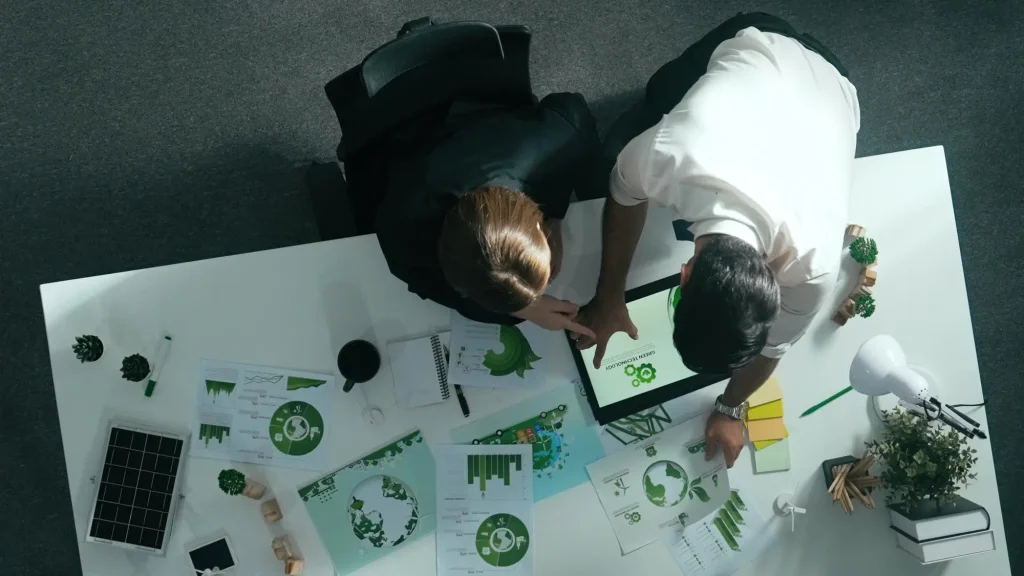
For a long time, sustainability was understood in the business world as a regulatory requirement or a matter of corporate image: something done because it has to be, or because it improves the company’s external perception. However, this view is incomplete today. More and more organizations are discovering that sustainability-oriented decisions have a direct, measurable impact on their competitiveness, their cost structure, or their ability to generate new revenue.
Efficiency: where savings and sustainability meet
The most immediate link between sustainability and economic results lies in resource efficiency. Reducing energy consumption, optimizing the use of raw materials, or minimizing waste are not just good environmental practices: they are, above all, decisions that directly reduce operating costs.
A company that reviews its electricity consumption, for example, not only lowers its carbon footprint but also frees up financial resources that can be directed to other priorities. The same happens with waste management or logistics optimization: more efficient processes tend to be, at the same time, more sustainable processes. This overlap is not a coincidence but a structural one: both goals ultimately pursue the same thing, eliminating what is unnecessary.
Savings as an effect, not the sole goal
It’s worth noting, however, that reducing sustainability solely to a matter of cost savings would be oversimplifying its scope. The real value appears when these improvements are integrated into the company’s strategy on an ongoing basis, not as one-off actions. Organizations that systematically review their processes under this lens tend to identify inefficiencies that would otherwise go unnoticed for years, simply because no one had considered reviewing them from this perspective.
New business opportunities
Beyond savings, sustainability also opens the door to business opportunities that didn’t exist before. Compliance with environmental and social criteria has often become a standard requirement in public procurement processes and in the supply chains of many large companies, which means that SMEs able to demonstrate good practices in this area gain access to markets and tenders that would otherwise be out of reach.
Likewise, demand is growing for products and services with a more responsible environmental profile, both among end consumers and among companies looking for suppliers aligned with their own sustainability commitments. Adapting to this trend early on can become a differentiating advantage over competitors who haven’t done so yet.
A strategic issue, not just a compliance one
The challenge for many companies, especially smaller ones, is to move from reactive sustainability —focused solely on complying with current regulations— to strategic sustainability, built into decision-making from the outset. This requires, first of all, a good understanding of the company’s own processes: what is consumed, what is wasted, and what impact the different activities of the business generate.
Based on that diagnosis, it becomes easier to identify where real opportunities for improvement exist, both in terms of internal efficiency and market positioning. Ultimately, sustainability and competitiveness are not opposing goals, but two sides of the same well-designed business strategy.
So how can the Galicia Economic Office help me in the field of CIRCULAR ECONOMY AND SUSTAINABILITY?
The support and advisory area on Circular Economy and Sustainability at the Galicia Economic Office is designed to support your company across all its various areas, providing agile, personalized solutions tailored to your specific needs. The experts involved in the program will work closely with your company to analyze your operations, identify areas for improvement, and design effective implementation strategies. Request your free advisory session.


