

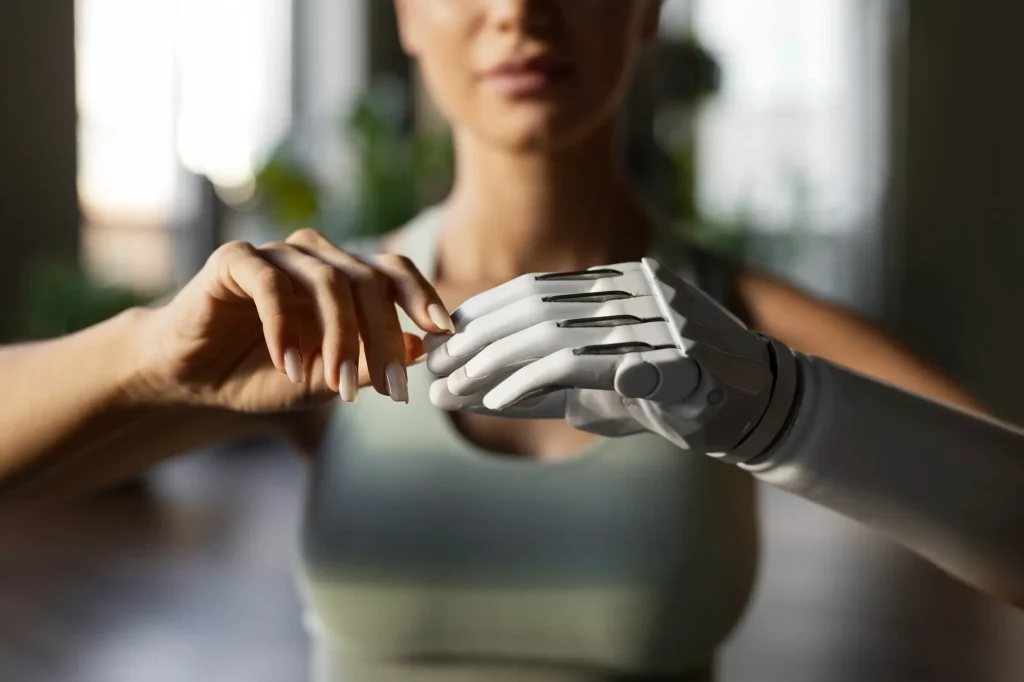
<p>Imagine that you use an Artificial Intelligence tool to create the logo for a new brand, an advertising campaign, or the text for your website. The result is excellent, but an inevitable question arises: can you consider that content to be yours? And, above all, is it legally protected?</p>
<p>Artificial Intelligence is transforming the way companies create content. Website copy, social media posts, designs, promotional images, videos, or even complete marketing campaigns can now be generated in a matter of seconds thanks to increasingly advanced tools.</p>
<p>This technological revolution has opened up new opportunities for SMEs, self-employed professionals, and entrepreneurial projects, giving them access to creative resources that were once reserved for large companies. However, it has also raised a key question: who actually owns content created with Artificial Intelligence?</p>
<p>The answer is not as simple as it may seem.</p>
<strong>Authorship remains linked to people</strong>
<p>Current regulations in Spain and the European Union are based on a fundamental principle: copyright originates from human intellectual creation.</p>
<p>This means that, in general terms, a work generated exclusively by Artificial Intelligence without any creative human intervention cannot be considered a work protected by copyright in the same way as a novel, photograph, or design created by a human author.</p>
<p>Current legislation does not recognize machines as authors, so legal protection remains linked to individuals who make their own creative contribution.</p>
<strong>What happens when a person uses an AI tool?</strong>
<p>In practice, most content generated with Artificial Intelligence is not completely autonomous. Behind it, there is usually a person who defines instructions, selects results, makes corrections, modifies elements, combines different proposals, or adapts the content to the specific needs of their business.</p>
<p>In these cases, the key issue is determining whether there is sufficient human creative input for the final work to be considered the result of an original intellectual creation.</p>
<p>For example, a person who uses an AI tool to generate an image and then modifies, edits, combines it with other elements, or makes substantial changes may be contributing a level of creativity that allows the final result to qualify for protection.</p>
<p>On the other hand, if the user simply enters a basic prompt and publishes the result without making any additional creative contribution, copyright protection may be more difficult to justify.</p>
<strong>Not all tools work the same way</strong>
<p>Another aspect that businesses should consider is that each Artificial Intelligence platform establishes its own terms of use.</p>
<p>Some tools allow generated content to be used freely for commercial purposes, while others may include limitations, specific conditions, or restrictions on certain uses.</p>
<p>For this reason, before incorporating AI-generated content into an advertising campaign, website, catalog, or communication strategy, it is advisable to review the terms and conditions of the tool being used.</p>
<strong>A legal landscape that continues to evolve</strong>
<p>The rapid expansion of these new tools is forcing regulators around the world to adapt to a technological reality that is evolving at great speed.</p>
<p>In recent years, debates surrounding the protection of AI-generated works, the use of content to train models, and ownership rights have become increasingly prominent on the international legal agenda.</p>
<p>Although the regulatory framework continues to evolve, the current trend still considers human involvement essential for a work to qualify for copyright protection.</p>
<strong>How can SMEs protect themselves?</strong>
<p>For small businesses and self-employed professionals using Artificial Intelligence tools, the main recommendation is to document the creative process and retain evidence of their involvement in developing the content.</p>
<p>It is also important to review the terms and conditions of the platforms being used and consider other forms of intellectual property protection when the content has significant strategic value for the business.</p>
<p>In a context where technology advances faster than regulation, the best protection remains combining the potential of Artificial Intelligence with human creativity.</p>
<p>Because, at least for now, copyright still has one thing in common: there must always be a person behind it.</p>
<p>Consult the experts at the Office of Economic Affairs of Galicia and request <a href=”https://asesoramento-oficinaeconomica.igape.es/inquiry/gl/stepper/?axisId=4&scopeId=19″>free advisory services</a> to help grow your business.</p>


